The Helsinki City Tourist & Convention Bureau’s Tourist Information offers free information about the city and its sights, events and services. Tourist Information provides tips and advice for making the most of your holiday. At the same time you can pick up brochures and maps.
The House of Culture in Helsinki is Aalto in his 'red brick period'. He achieves the free-form curves of the concert hall walls using wedge-shaped bricks, arranged variously with their shorter edge facing inside or outside the wall. The impact of the solid brick walls must be seen in the context of what had gone before. In Finland, the National-Romanics had used wood and granite to show closeness to Finnish nature, while the modern movement (as elsewhere) used more abstract white plaster surfaces (which did not wear well particularly in the Finnish climate). Aalto's red brick was therefore a bigger statement than it now seems: a man-made material that keeps its individuality and local personality.
Helsinki’s climate is typical of its northerly situation. Its intermediate climate combines characteristics of both a maritime and a continental climate. The proximity of the Arctic Ocean and the North Atlantic creates cold weather, while the Gulf Stream brings in warmer air.
|
|-
|
|-
|
|-
|
|-
|
|-
|
|}
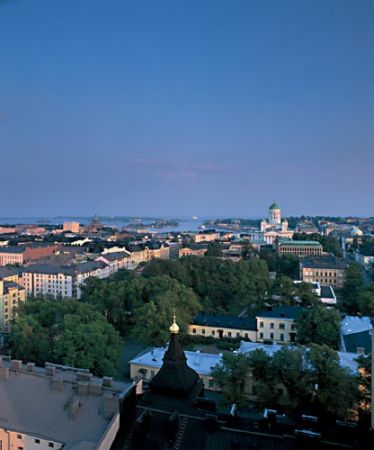
Helsinki (uitspraak: helsinki, met de klemtoon op de eerste lettergreep; Zweeds: Helsingfors) is de hoofdstad van de Republiek Finland. De stad ligt aan de zuidkust van het land aan de Finse Golf. Helsinki is tevens de grootste stad en in alle opzichten het centrum van het land. De gemeente Helsinki telt ongeveer 590. 000 inwoners; het stedelijk gebied heeft echter rond de één miljoen inwoners, zodat bijna een vijfde van de totale Finse bevolking in en om de stad woont.
Helsinki is een tweetalige gemeente met Fins als meerderheidstaal (± 86%) en Zweeds als minderheidstaal (± 6%).
Description above from the Wikipedia, licensed under CC-BY-SA full list of contributors
here.